Why Version Control
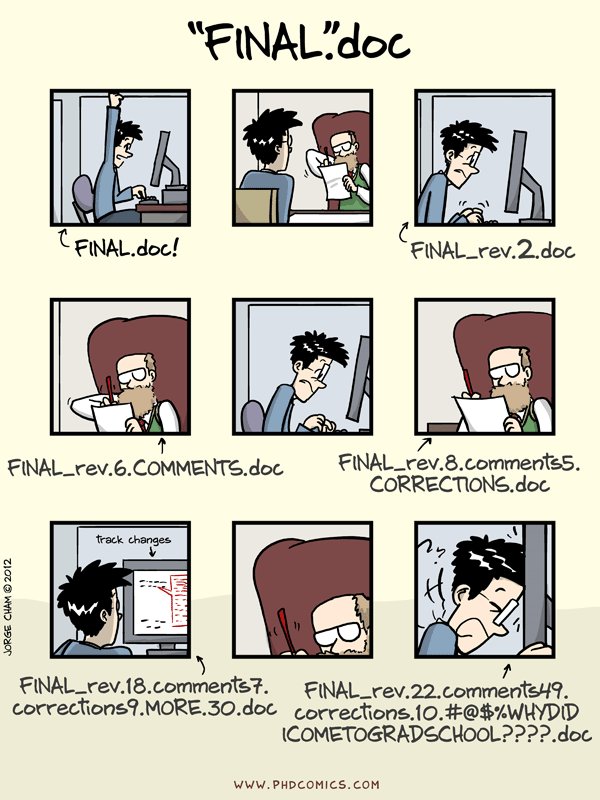
“Final”.doc, Jorge Cham, PHD Comics
If you’ve ever ended up with Final.doc, then Final_v2.doc, then
Final_v2_reallyfinal.doc — you’ve already felt the problem a version
control system (VCS) solves. A VCS keeps a repository of every version of
every file, replicated on each contributor’s machine, and can answer: what
changed between the run that worked and now? Who changed the code or data,
and why? Can I get back exactly what we had before? Git is the dominant
example — a distributed VCS, meaning every clone carries the full history,
not just a snapshot Chacon & Straub, 2014.
Branching, Merging, and Pull Requests
A branch is an independent line of work off the main history; git branch
shows which one you’re on. Two people can each commit to their own branch,
then merge one into the other — Git resolves this automatically when the
changes don’t overlap, and asks you to resolve a conflict by hand when they
do (e.g., two different values proposed for the same line).
A pull request (or “merge request” on GitLab) is a proposal to merge one branch into another, opened for discussion and review before it happens — the mechanism, on GitHub, by which an outside contributor proposes a change without touching the main branch directly.
Hosting and Long-Term Availability
Git still needs a server to host the shared repository: a hosting service (GitHub, GitLab, Bitbucket, or the non-profit Codeberg — see this comparison) or a self-hosted server, which trades convenience for control and a real maintenance burden.
Cloning (a native Git feature) gets you a local copy without changing who owns the project. Forking (a hosting-service feature, not a Git one) makes you the owner of your own copy, which you can modify freely and later propose back to the original project via a pull request.
Releases and Distribution
A Git tag is a named pointer to a specific commit; GitHub turns a tag into a release — a changelog, a link to that commit, and a bundle of the source code (e.g., NumPy 2.0, or Node.js’s odd-numbered “experimental” releases). What a release actually ships varies:
Source + install instructions (e.g., the NVM install script)
Source + build instructions (e.g., building PyTorch from source)
Prebuilt binaries (e.g., VLC, or a PyPI package installed with
pip)All of the above (e.g., Node.js: binaries, build docs, and
npm)
Dependencies are usually kept out of the repository and declared instead
(requirements.txt, package.json) — pinning exact versions
(package-lock.json) is what makes an install reproducible later.
Reproducible Environments
The same code can fail on a different OS, a different library version, or a
port already in use — “works on my machine” is a real, recurring failure
mode. Two ways to package an environment against it: a virtual machine
(a full OS emulation — heavy, but complete) or a container, most
commonly Docker (lightweight, Linux-kernel-based, configured in a
Dockerfile). Within a single language, Python’s venv isolates
dependencies per project — commit requirements.txt, never the .venv/
folder — and conda goes further, managing Python itself alongside
non-Python dependencies (compilers, CUDA, R) via a committed
environment.yml.
CI/CD
Continuous Integration automates checking new code on every push, on a clean machine: if it builds and the tests pass there, it’ll work for your reviewer, your colleague, and future you. Continuous Deployment then publishes something automatically once checks pass — a release, a doc site, a Docker image. On GitHub, this is Actions: workflows built from reusable blocks plus shell commands, which can also gate a pull request on tests passing.
Version Control and Open Science
Version control supports reproducibility directly: it ties changes in results to changes in code, gives publications a stable reference point, and automates the change history that makes replication attempts possible Ram, 2013. Lecture 4 picks this up for data and computational environments specifically.
Further Resources
Pro Git — the free, canonical Git book (Chacon & Straub, cited in References)
- Chacon, S., & Straub, B. (2014). Pro Git (2nd ed.). Apress. 10.1007/978-1-4842-0076-6
- Ram, K. (2013). Git Can Facilitate Greater Reproducibility and Increased Transparency in Science. Source Code for Biology and Medicine, 8, 7. 10.1186/1751-0473-8-7